
ESGE Individual Membership includes subscription to Endoscopy and other interesting benefits for you like reduced registration fees for special meetings or the ESGE DVD Encyclopedia.
Find out more:
» ESGE website
October 20-24, 2012 – 20th United European Gastroenterology Week (UEGW)
Welcome to the SFED!
Current Issue April 2012
Endoscopist-directed propofol administration versus anesthesiologist assistance for colorectal cancer screening: a cost–effectiveness analysis (FREE ACCESS)
C. Hassan, D. K. Rex, G. S. Cooper, R. Benamouzig
This cost–effectiveness analysis compares endoscopist-directed and anesthetist-assisted propofol sedation in populations in the United States and Europe. In a base-case scenario, cost savings for endoscopist-directed sedation would be substantial (US $3.2 billion and France €0.8 billion, over 10 years). Even when a minimal mortality with endoscopist-directed propofol sedation is considered in a sensitivity analysis, anesthetist-assisted sedation would cost $1.5 million per life-year gained – far beyond the accepted societal threshold of cost-effective care.
Withdrawal time as a quality indicator for colonoscopy – a nationwide analysis (FREE ACCESS)
V. Moritz, M. Bretthauer, H. K. Ruud, T. Glomsaker, T. de Lange, P. Sandvei, G. Huppertz-Hauss, Ø. Kjellevold, G. Hoff
The value of withdrawal time as a colonoscopy quality indicator was explored in a nationwide analysis (19 Norwegian centers). Withdrawal time using 6 minutes as the threshold was not found to be a strong predictor of polyp detection. The adjusted odds ratio for the detection of polyps ≥5 mm was 1.21 (95%CI 0.94–1.56, P= 0.14) when comparing endoscopists with median withdrawal times of at least 6 minutes and less than 6 minutes.
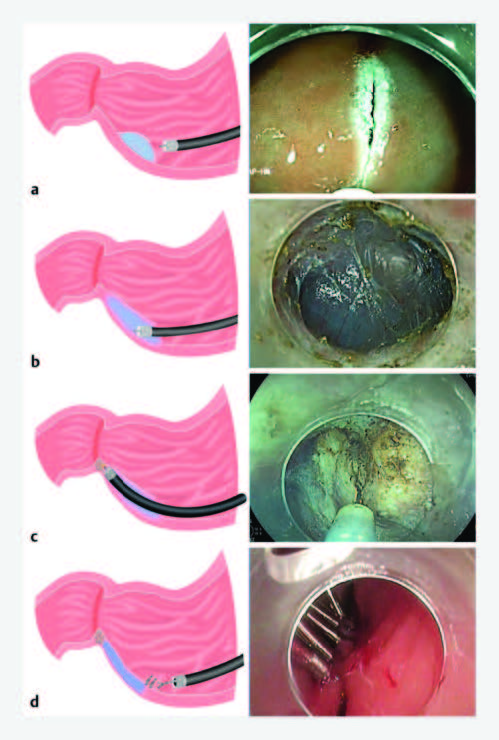
Transgastric endoscopic gastroenterostomy using a partially covered occluder – a canine feasibility study (FREE ACCESS) ![]()
H. Luo, Y. Pan, L. Min, L. Zhao, J. Li, J. Leung, L. Xue, Z. Yin, X. Liu, Z. Liu, A. Sun, C. Li, K. Wu, X. Guo, D. Fan
A novel method of creating a gastroenterostomy using natural orifice transluminal endoscopic surgery (NOTES) with an occluder was reported. The technique was investigated in 12 healthy female dogs using a therapeutic upper gastrointestinal endoscope and a partially covered occluder, which was removed 1 week later. Placement was technically successful without anastomotic leakage or intestinal obstruction, and with complete healing of the anastomosis on histological evaluation. Although the outcomes were very promising, confirmation in a human study is needed.
Colon capsule endoscopy: European Society of Gastrointestinal Endoscopy (ESGE) Guideline (FREE ACCESS)
C. Spada, C. Hassan, J. P. Galmiche, H. Neuhaus, J. M. Dumonceau, S. Adler, O. Epstein, G. Gay, M. Pennazio, D. K. Rex, R. Benamouzig, R. de Franchis, M. Delvaux, J. Devière, R. Eliakim, C. Fraser, F. Hagenmuller, J. M. Herrerias, M. Keuchel, F. Macrae, M. Munoz-Navas, T. Ponchon, E. Quintero, M. E. Riccioni, E. Rondonotti, R. Marmo, J. J. Sung, H. Tajiri, E. Toth, K. Triantafyllou, A. Van Gossum, G. Costamagna
PillCam colon capsule endoscopy (CCE) is an innovative noninvasive, and painless ingestible capsule technique that allows exploration of the colon without the need for sedation and gas insufflation. Although it is already available in European and other countries, the clinical indications for CCE as well as the reporting and work-up of findings from the procedure have not yet been standardized. The aim of this evidence-based and consensus-based guideline, commissioned by the European Society of Gastrointestinal Endoscopy (ESGE) is to furnish healthcare providers with a comprehensive framework for potential implementation of this technique in a clinical setting.